Saturday, 4 August 2012

On Board the Bernina Express to St.Moritz

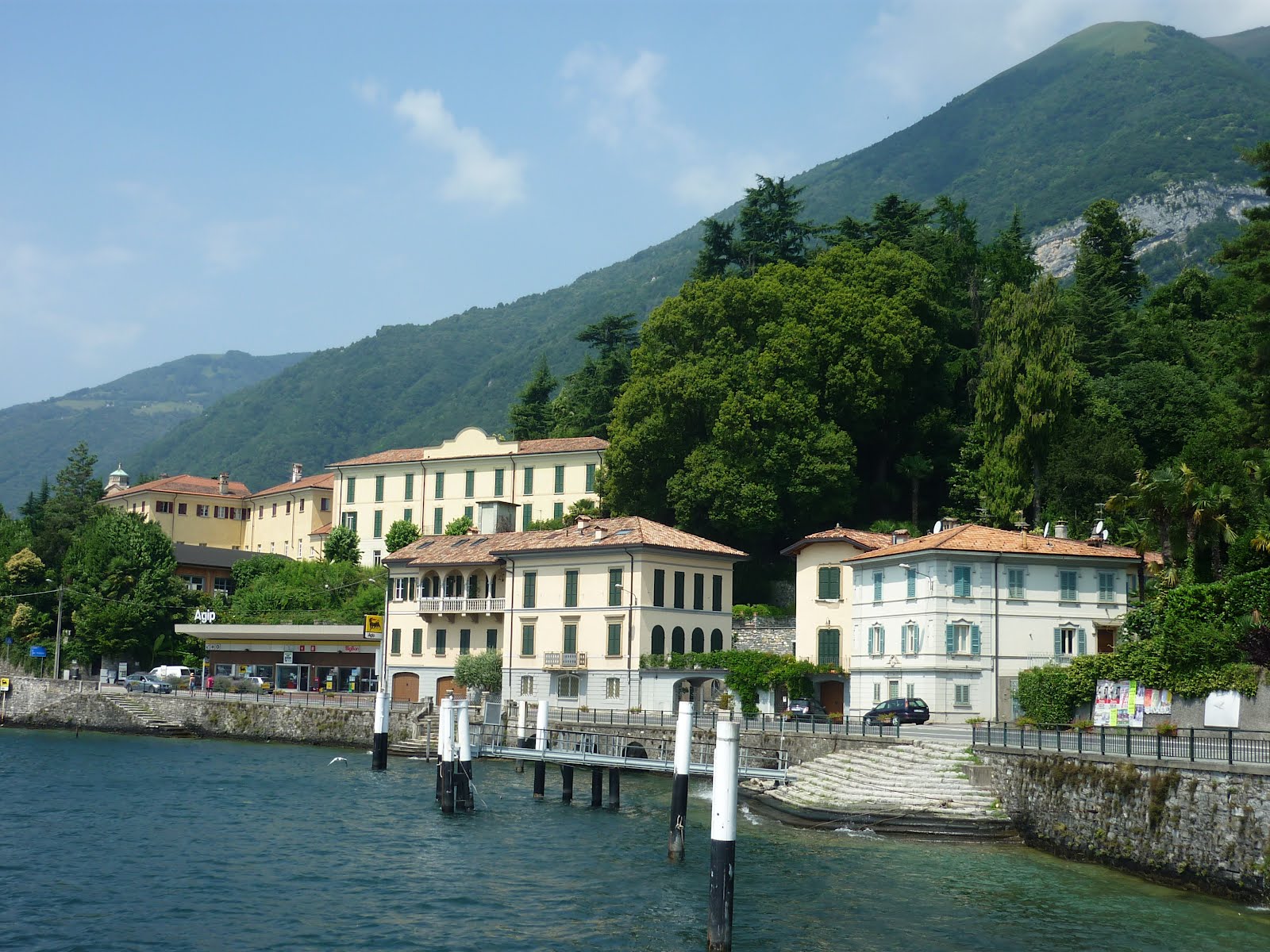
Part of the fun of sitting out on our balcony overlooking Lake Como is watching the various activities of the lake … ferries of different shapes and sizes, small motorboats, seaplanes and occasionally traditional Italian rowing boats (in which two oarsmen stand as they row). While the lake is a watery stage for a myriad of activities, the backdrop to all this is the magnificent mountain range of the Alps which straddle the border between Italy and Switzerland. In anticipation of even more spectacular scenery, Jules and I were keen to explore them further by heading toward the border and hopping on the Bernina Express that heads towards St. Moritz.

We boarded the weekly tour bus that leaves from Menaggio to find that many other tourists (mostly Brits) had a similar idea, particularly as the weather forecast promised a clear and sunny day in the Alps. These sort of group tours are not normally our type of thing, but for economy of time and the opportunity to travel on one of the highest (over 2000 metres above sea level) and most picturesque railway journeys of the world, we were prepared to be herded along.

Travelling by coach toward to the northern end of Lake Como, we pass through the little lakeside town of Dongo and are reminded by our tour guide that this was the location for the dramatic capture of Benito Mussolini and his mistress toward the end of World War II. Heading for the neutral Swiss border and with the Alps in sight, ‘il Duce’ must have thought that he was just about safe, until partisans stumbled upon him and swiftly delivered their vengeful justice. In thankfully more peaceful times, this area is now one of Italy’s major wine regions with vineyards stretching high into the slopes of the nearby hills. Arriving at the border town of Tirano, there was time to view the elaborate Basilica of the Madonna, which is said to have been the site of an apparition of the Virgin Mary in the 16th century and continues to attract pilgrims each year in search of divine miracles. However, what is more significant to us is that it is here that we get our first glimpse of the Bernina Express, which literally cuts through the centre of the town.

We cross the Swiss border and in order to save some time, board the train in Poschiavo to begin a slow winding accent toward Bernina Diavolezza. This is a spectacular run that sees us traveling over viaducts toward the extraordinary Bernina Pass with its snow capped peaks, milky blue lakes and ancient glacier. Not surprisingly, the pass and the railway line that threads its way through it are listed as UNESCO world heritage sites and even in summer it is a remarkable landscape that had both ourselves and the Brits continually snapping our cameras. The time passed quickly and we were soon back on the bus for the final run into St.Moritz, a place that has long been regarded as a winter playground of the rich and famous. While the town provided some nice scenic outlooks, a pretty alpine lake and of course the end point for the legendary Cresta Run (a three quarter of a mile toboggan racing track), we felt that as a town it was somewhat of an anti-climax. Similar to cities like Monaco, there is artificiality and a manicured nature to such places that make them somewhat cold and impersonal. As we were warned, the shopping was outrageously expensive and the best we could manage was a vanilla custard slice (quite delicious, I must say) and an ice-cream (not a patch on Italian gelato). No doubt St.Moritz is a winter wonderland when the snow falls and you’re cashed up for the season, but for now, we were just happy to head back to Italy.

On our return however, we had an unexpected surprise when we crossed over the Italian border and made a brief stop in Chiavenna. Nestled in a mountainous valley, this beautiful medieval village exuded all the charm that we have come to expect when venturing outside the major tourists spots. Narrow laneways, picturesque buildings and piazzas complete with water fountains, which can all be summed up in one simple word ... ‘character’! Running through the heart of the town was a rocky stream that flowed with icy clear water of melted snow from the mountains above, which was spanned by an ancient arched bridge. As we looked down, a local man who clearly sensed that we were visitors, came alongside and began to throw bread into the stream, encouraging excitable trout to the surface. Not to be out done, Jules reached into her bag to bring out a bag of dried bread sticks and did the same. At that point we both wished that we had more time to spend in Chiavenna rather than in St. Moritz. While we had thoroughly enjoyed the trip, in particular the wonderful scenery of the Bernina Pass, it had again reminded us about which side of the border we preferred and for us this time there was no simply comparison.

Saturday, 28 July 2012

Living the Life on Lake Como

Heading north out of Milan by rail was much like leaving (or entering for that matter) any other big European city, plenty of grime and plenty of graffiti. There was certainly no indication of the breathtaking beauty that we were about to experience just one hour away at Lake Como. However, upon reaching the end of the line in the town of Como, we knew that we were in for something special when we walked out of the station to see the great lake stretched out before us like an endless blue runway.

Jules had been planning our visit here for months in advance, scouring the internet for the perfect holiday rental that would provide the unique combination of a truly authentic Italian experience combined with all of the necessary holiday comforts and conveniences. She thought that she had found such a place in Argegno, a slightly lesser known tourist town than Bellagio, Menaggio or Varenna, but with the important common feature of being right on the waters edge. It also had one other added attraction for Jules and that was being the neighboring town of Laglio, which any celebrity watcher knows is where George Clooney chooses to spend his summer vacations (Jules would continue to live in hope of a chance meeting throughout our stay). While George was nowhere in sight as we passed through on the bus, what did become apparent as we weaved around the coastline was the increasingly stunning lakeside views. As we headed closer to our destination, an American girl lent over to ask whether the next stop was in fact Argegno. She went on to explain that her and her two friends had traveled up from Milan for the day just for a swim in the pristine waters and with much of the lake having limited public access, they had read that this was one of the few spots they might be able to wade in. We all hopped off the bus heading in different directions; for them it was the water and for us, the hills. We actually saw the girls later in the afternoon and it seemed that they had indeed fulfilled their mission and with dripping hair they were about to begin their long trip back to Milan. We on the other hand, would be spending a much longer time here (two weeks in fact) in a house only a stones throw from the waters edge and with majestic views of the alpine peaks beyond. It would be from our balcony overlooking the lake that we would recite our regular mantra… ‘how good is this?’… several times a day!

It wasn’t too long before we were exploring the numerous lakeside towns using the regular ferries that ply these waters. For those in a hurry, there was the ‘servizio rapido’ (hydrofoil) service, but for the rest of us, with time on our hands, the regular ‘slow ferry’ would move at a pace that allowed us to do some sunbathing between taking regular photographs of the ever-changing scenery. This surely was the best way to take in the scale and beauty of Lake Como and its surrounding towns; each with it’s classic window-shuttered buildings, painted in umpteen shades of terracotta. Clinging onto the steep mountain slopes, these closely stacked buildings were generally simple and rustic, separated by narrow laneways, providing a romanticism that is unique to Italy. Jules and I would spend many an hour analyzing and dissecting the qualities of each town while sitting in the local cafes and restaurants. I must admit that gazing at unbelievable views and eating Italian dishes with a glass of vino or cold beer was a pretty nice way to spend an afternoon. Not surprisingly, it soon became our regular pastime as we tried to determine the most picturesque town. After much deliberation we eventually awarded that honor to Varenna, as much for its serenity (due to the lack of cars) as the quintessential charm of its old town.

Despite our regular journeys around the lake, at the end of the day we were always happy to return to Argegno. We had not seen a better view of Lake Como than from our very own balcony, unless of course you discounted the outlook from Pigra. This is a small town that sits on top of the mountains above Argegno and by boarding a tiny cable car, you can stand on a summit almost 1000 metres high. The aerial view from here was pretty special indeed and provided us with yet another reminder of the sheer scale of the lake and overlapping mountain ranges that continued endlessly through to Switzerland. Back in the village, Jules was increasingly making herself known to the locals. Most mornings she would head off to visit the lady in the grocery store, the baker and her friendly fruit and veg man, who were all very welcoming. They would encourage her to use Italian language, while providing just enough English to act as a safety net if she couldn’t quite find the words. She would return with bags of delicious goodies and fuelled with inspiration to cook. As she loaded her ingredients into the fridge, she would look at me and say with a smile … ‘I could get used to this!’

The view from our balcony!

Saturday, 21 July 2012

24 Hours in Milan

Following a two and half hour train journey from Venice, we arrive in Milan around midday on a warm Sunday afternoon. As we dragged our suitcases out of the train station, we find a somewhat different outlook than the picture perfect spot we had just left a few hours earlier. The city is very quiet and the buildings appear dull and grey from years exposure to car fumes. The shutters of the shops are rolled down exposing endless panels of ugly graffiti that appear to have been there for years. Our immediate introduction to Milan is seedy and uninviting and with a few shady looking characters wandering around, we are keen to keep moving toward our more centrally located hotel. Thankfully as we get closer the to the centre of the city, the scene slowly begins to improve, with more signs of life and the place looks distinctly cleaner and safer. By the time we reach the hotel, we can see some shops open, street cafes and a leafy park in the distance, while the occasional tram is now bustling down the main road. We had read mixed opinions about Milan and at this stage our opinion too was mixed; perhaps in 24 hours we would know better!

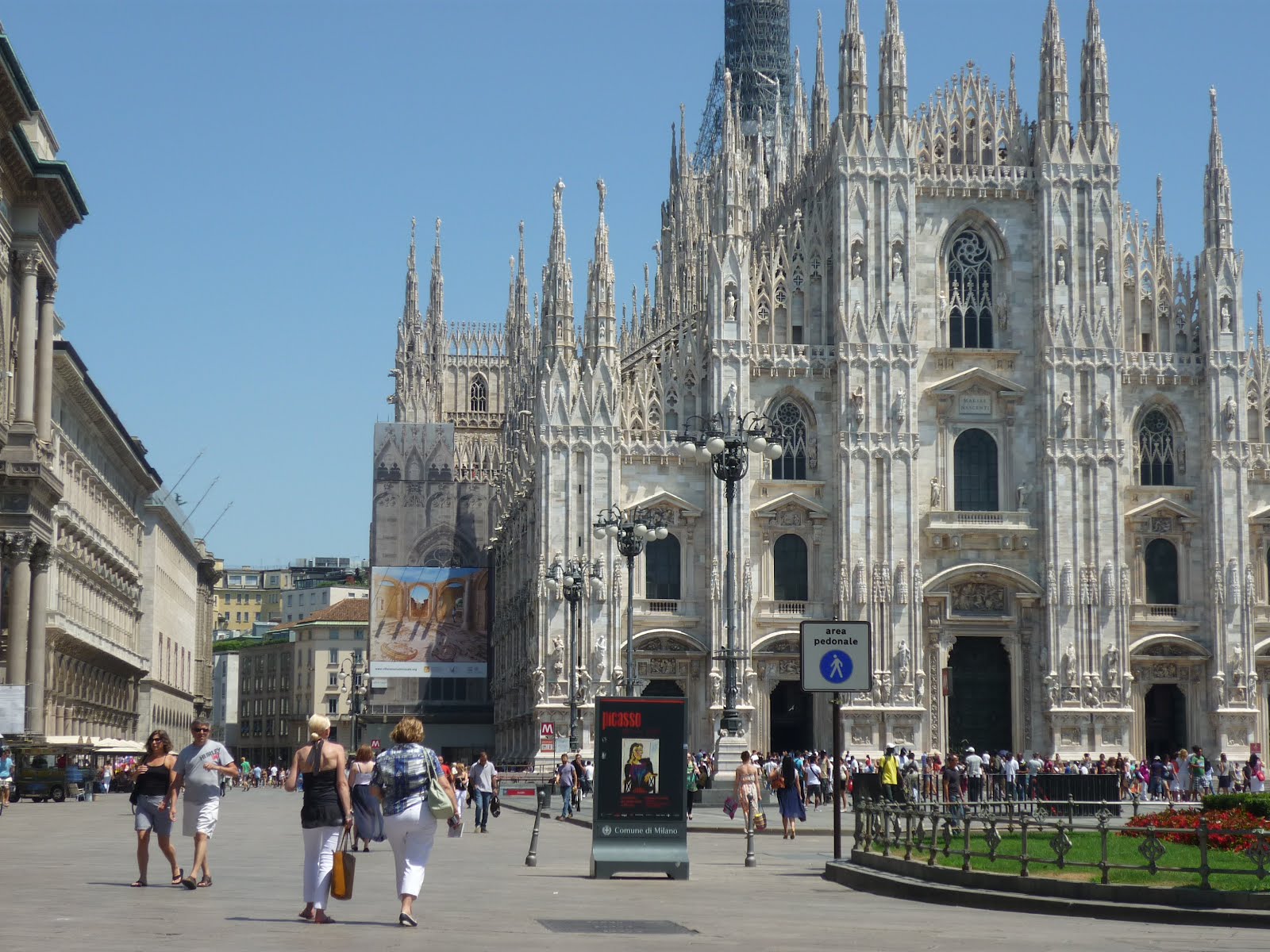
Our plan is to meet with our son Dave and his fiancé Cara in Milan then travel one-hour north by train to Lake Como to enjoy some time together in a lakeside house that Jules had managed to organize months before our arrival in Italy. As we are all leaving the next morning, we plan to spend the afternoon and evening catching up while exploring what downtown Milan has to offer. We immediately head toward Piazza Del Duomo, which is the most significant of the cities tourist spots and is dominated by the enormous and highly elaborate Milan Cathedral. Unlike the buildings near the railway station, everything in the square appears to have been recently cleaned, with only the spires of the cathedral and the equestrian statue of King Victor Immanuel II undergoing the final touches of renovation. You really have to pay credit to the Italians, they really know how to build a public square and this is certainly one of their most impressive, both in its scale and overwhelming attention to architectural detail. It has been over a year since seeing Dave and Cara so this is the perfect spot to sit in one of the many cafes that surround the piazza to enjoy a cool drink and exchange news while marveling at the sheer grandeur of our surroundings.

Before too long, we can’t resist the opportunity to explore the nearby Museo Del Novecento (The Museum of Contemporary Art), not just for its fine collection of modern art, but also for the spectacular elevated views it provides overlooking the Duomo. From here you can clearly see the Galleria Victor Emanuele II Arcade (clearly he was very popular in Milan) and we are particularly keen to venture through the formidable entrance into what must be one of the most beautiful under cover shopping malls in the world. Built in the mid 1800’s, the Italians again demonstrated their sense of design, style and ingenuity by building an enormous arched glass and wrought iron roof that is both functional and elegant. The Galleria is filled with all of the major designer brands, confirming Milan’s reputation of one of the great design and fashion capitals of the world. Towards the centre of the arcade, the floor mosaic reveals the Turin coat of arms and following Jules’ suggestion, we spin on it three times for good luck, as is the popular
tradition.

If Venice was all about tourism, Milan  appeared to be more about business (even on a Sunday afternoon), but as we headed back toward the hotel, there seemed to be some quite obvious divides between the various strata within its society. While designer shops spread out far and wide from the central galleria, with plenty of ‘beautiful’ people frequenting them, there also appears to be an equal number of those battling to buy into this glamorous world. I guess it isn't unlike many of the big cities of the world that we have visited over the years, but having just arrived from idyllic, egalitarian Venice, it seemed all the more obvious.

In the evening Milan’s apparent indifference to tourism certainly worked in our favor as we enjoyed our best meal in Italy so far, at a small alfresco restaurant in a laneway not far from our hotel. We had so often been under whelmed with the meals we had eaten in the more obvious tourist spots (as if just being there was enough without expecting the good authentic food too), so we were pleased to finally enjoy a truly Italian meal with a contemporary twist. Around the corner there was an authentic wood oven pizza restaurant with people queuing out the door, but that would have to wait for another time. Tomorrow we would leave the big city streets of Milan and head for the solitude of the Lakes, only to return in two weeks time when we can explore here further. Within the space of 24 hours we had arrived and departed, only just beginning to scratch the surface of this ‘gritty’ and somewhat contrasting city…there was still much to see and we would be back!

Friday, 13 July 2012

In Search of Venetian Art

While the city of Venice has traditionally provided wonderful subject matter for artists throughout the centuries, it also shares the distinction (with Florence) as being a major centre for Italian renaissance. In those days, it’s buoyant trading economy provided much needed support for artists that enabled painters, sculptors, glassmakers, ceramicists, woodworkers and lace makers to make a comfortable living. Today there are several major galleries and museums, while there still remains hundreds of smaller studios/galleries to be viewed. To this end, Jules and I tended to spend most of the daylight hours wandering the canals and laneways searching them out.

If you are into renaissance art and architecture, there is plenty to see with the Academia Gallery (that includes Leonardo Da Vinci’s famous drawing of ‘Vitruvian Man‘), Scoula Grande di San Rocco, Doges Palace and more. However, our tastes tend to lean to the more modern so we begun our tour with Ca’ Pesaro - International gallery of Modern Art, which features many notable works from the nineteenth and twentieth centuries. The birth of modernism is certainly not lost in this beautiful city and with the Museo Correr hosting a major touring exhibition of the works of Gustav Klimt, that just had to be viewed. The exhibition would also provide a nice introduction to Viennese Secessionist art that we were set to fully experience in a few weeks time.

However, the most impressive collection of modernist works to be found in Venice were certainly on display in the Peggy Guggenheim Collection, which is situated in the former home of this art collector, bohemian and socialite. While I knew a little bit about Solomon Guggenheim (her uncle) and had visited the Guggenheim museum in New York, I did not know too much about this extraordinary lady and the amazing collection of modern art she amassed in Europe during her lifetime. While many private collections often include minor work by significant artists, we were amazed at the quality of her collection that included many major works from the who’s who of twentieth century art. Jules and I realty enjoyed wandering around the rooms in which she had lived, which was brought to life even more vividly by photos taken of her in these very spaces back in the day. As we sat on her patio facing the Grand Canal, we thought what a life she must have led in the company of some of the greatest artists of the time in one of the most beautiful cities of the world.

For the really contemporary stuff we just had to visit Palazzo Grassi and Punta Della Dogana. These galleries were situated in different parts of Venice, but they appeared intrinsically linked by their representation of the very latest in conceptual art. We viewed a very thought provoking show by Urs Fischer at the Palazzo Grazzi and a variety of other challenging pieces (although less to our taste) in the Punta Della Dogana (which has a Japanese connection with the building being recently redesigned by noted architect Tadeo Ando). With the Venice Biennale established in 1895, this city has built a strong reputation over the years as arguably the most significant forum for innovative art held in the world. Today, with representatives from over 30 countries establishing their own ‘art pavilions’, it continues to attract the worlds leading contemporary artists and of course, thousands of art lovers every second year in celebration of the visual arts. For your work to be represented here is to know that you have truly made it in the art world!

While the big galleries were outstanding, many of the smaller ones also impressed us and we could sense that a real art community existed here which would be the envy of most other cities. As we wandered around the picturesque laneways and canals, Jules and I could quite easily imagine ourselves eking out an existence in a tiny studio in Dorsoduro (the arty part of town); living on pasta and wine and being inspired daily by these wonderful surroundings, as artists have done here for centuries.

Monday, 9 July 2012

The Magic of Venice

After two previous trips to Italy, which we had thoroughly enjoyed, Jules and I finally made it to Venice. We had interestingly heard so many mixed reactions to this tourist hot spot over the years with previous visitors criticising such things as it’s commercialism, packed streets, the rip off prices, the graffiti, smelly canals and even the run down conditions of its buildings. So with some degree of apprehension, we arrived by boat into this unique and historic city, only to be immediately ‘blown away’ by so many wonderfully clichĂ©d sights! As we would discover, all of the things they had spoken about seemed to be absolutely true, but this was Venice after all and in the height of summer it was just a stunning place to be and all could be forgiven!

Wisely, Jules had organized accommodation in a small hotel in the Dorsoduro district, which is noted for its university and large student population, but more importantly it was a nice distance from the tourist trappings of the St. Marco area. From here we could easily walk over to the wooden Academie Bridge for one of the most picturesque city walks that you could ever hope to experience. As we strolled to the central square, we were frequently tempted to stop at the numerous Murano glass shops, galleries or gelati vendors that lined the route. However, the thing which stopped us in our tracks the most was simply the scenery … Bellisimo!! As we passed over quaint canal bridges, there always seemed to be a scene worthy of the best glossy coffee table book that just had to be photographed. Craning our necks in all directions, it was hard not to look like a tourist, but thankfully with thousands of others doing exactly the same thing we didn’t appear entirely out of place.

Of course the magnet that draws the people from throughout the world is St. Mark’s Square and at any given time there appears to be thousands of tourists milling around admiring what is arguably the most picturesque piazza in Italy. The sight of the Basilica, Bell Tower and Doges Palace are familiar images that have provided the subject matter for literally thousands of memorable paintings. It seems that at some stage, just about every artist of note has visited Venice over the centuries and found inspiration from this truly unique place.

One of the most unexpected features of Venice that we had not anticipated was its quietness. In a place that relies entirely on its countless waterways for transportation, there is a peacefulness that has long been forgotten in our car dominated cities. No noisy engines, beeping horns or screeching tires, no smog, no traffic lights, just walking or boating … simply wonderful! There was something so intrinsically appealing in sitting at the waters edge, watching the boats (of all shapes and sizes) move leisurely up and down the Grand Canal. Of course, the famed Gondolas still provided the most romantic way to slowly navigate the narrow canals and remain as popular as ever.

On a summer night Venice really comes into its own, with countless piazzas and laneways filled with outdoor bars and restaurants with just the sounds of good conversation, laughter and the clinking of glasses and cutlery. On one of the days we were there, the university graduation ceremony was held, so that evening was particularly celebratory. Yet on any given night we found the atmosphere equally as happy and relaxed. As we walked out of a local jazz club on our final night, Jules and I reflected back on the appeal of Venice. Sure, in the height of summer we had seen it in its best possible light, but despite its age and obvious trappings of tourism, it still provided a special piece of magic that for us as seasoned travelers was quite unexpected.

Sunday, 1 July 2012

Buying a Japanese House

Living on the outskirts of Osaka, our residential area continues to expand with blocks of land being quickly snapped up and new buildings appearing just months later. Not surprisingly, a ‘housing display park’ has been established within walking distance of our apartment that shows popular styles from many of the leading builders. Not that we’re in the market for buying a new home, but Jules and I couldn’t resist the temptation to pop in and pretend as if we were.

Upon entering, we were initially struck by the sheer size of the gated complex, with some 55 fully furnished homes on display. Unlike display houses in Australia that might have consisted of possibly 6 homes, this was in fact a small neigbourhood that required a street map in order for us to make our way around. As we looked down the roads, we could see some of the typical features of Japanese selling…the use of strange inflated cartoon like characters, which in this case were emerging from several of the first floor balconies. We’re still not quite sure how this approach is supposed to encourage you to buy a house, but we can only assume that if the display is interesting enough to entice small children, perhaps the parents will quickly follow. With an average Japanese house costing anything between 9 -16 million Yen (approx. A$110,000 – 195,000) this is no small purchase and that is assuming that the customer has already invested into a block of land, which is generally more expensive than the actual house itself (despite often being only slightly larger than a postage stamp). So every little incentive is used (including even a lottery draw for small prizes at one house we viewed) to encourage you to take those first tentative steps toward house ownership by simply walking through the doors to view the sample home. Each of the sales staff are particularly attentive (even more so than usual), often standing at the front door with an inviting smile and encouraging you to enter. Leaving our shoes at the door (as is tradition) we were provided with slippers then the mandatory house plan, while the assistant politely followed at a discreet distance behind, eager to answer questions or generally sell the merit of the design (sadly much of the sales ‘patter’ was wasted on us).

The interesting thing that we have learnt about new build housing in Japan is that each home is only expected to last 25 – 30 years and that just like buying a new car, houses depreciate rather than appreciate in value as they get older. It is the land that holds its value, while houses will be eventually demolished to make way for the next generation of design. However for most people, buying a house remains a one off purchase and much effort is made to ensure that it will fulfill the families current and future needs. Despite their small building footprint, most houses pack quite a lot into the design and with many buildings standing three stories tall, there is a surprising amount of space. We found that the Japanese genkan (the entry way where shoes are removed) were now wide and inviting areas, while many homes still found space to incorporate the traditional ‘tatami room’, although often designed with a slightly modern twist. We were pleased that the ‘wet room’ approach to the shower/bathroom had been retained, as this is a concept that Jules and I have increasingly grown to appreciate. Thankfully, ‘futon’ style sleeping and squat toilets appear to have become relics of the past! There is now clear evidence that the Japanese are seeking modernity in their homes with greater emphasis upon kitchen (which Jules loved) and the entertainment areas (which I loved), while the emergence of a new space called the ‘communication centre’ reflected the growing amount of time spent on the computer. We were amazed at the amount of designs we viewed that were clearly influenced by the prairie style of Frank Lloyd Wright, with their use of woodwork, stone and cantilever style roofing. This is quite ironic as the great American designer cited traditional Japanese architecture as his only genuine influence upon his own style during the early 1900’s. Somehow this approach to design had now become totally reversed with one of the salesmen proudly pointing out the reproduction lighting and panel work, the originals of which we had seen only last year when visiting one of Wrights greatest homes, ‘Fallingwater’.

After spending several enjoyable hours at the ‘housing display park’, we left not only with a bag of brochures, but also with a new appreciation for modern Japanese housing. We weren’t buying into the Japanese dream just yet, but as always with this type of experience, it was fun imagining what living in these homes might actually be like. So it was back to the apartment for us, but the next time we walk by a new build home, at least we will have some understanding about the interior design behind the front door and what it takes to buy a Japanese house.

Sunday, 27 May 2012

Temple of a Thousand Buddhas

As mentioned previously, Buddhism still remains a mystery to both Jules and myself. Yet, since we have lived here, we’ve developed a healthy respect for its traditions and rituals as well as the various art forms that seek to represent it. As a cultural influence, it is so deeply embedded into the grain of Japanese life that its presence can be felt everywhere as we move around the country. Temples abound, each filled with sacred objects and diverse representations from the Buddhist faith. While many look very similar, we occasionally come across something that is quite unique. Such was the case with the Sanjusangendo Temple in Kyoto, which surprised us in terms of both its scale and visual impact.

This 12th century ‘long building’ is in itself quite monumental, but it is the interior that provides the surprise. It houses the most amazing assemblages of life-sized Buddha statues that are carefully arranged in 10 rows of 100. Covered in gold leaf, each are positioned in a standing pose and while they are said to be identical, the hand-made nature of each figure provides some nice subtle variations to their facial features. Directly in the centre of the mass of statues is a large gold Buddha and interspersed along the full length of the figures are 28 fierce looking guardian deities (supernatural beings).

As it is a sacred place, Jules and I removed our shoes to enter the wooden structure that has seen few changes over the centuries. As we rounded the corner the sight of the seemingly endless line of golden statues created quite an impact. The scale and order of the formation was impressive with each row rising up a level as it moved back. Naturally we had the camera at the ready, but were dashed at the last minute by a large threatening sign forbidding any images from being taken (not usually the case in Japan). We wondered whether this was a religious thing or the custodians simply protecting their commercial asset? Possibly the latter, as it seemed that religious propriety didn’t quite apply to the souvenir shop next door.

While we strolled the long walk passed all of the figures, we were amazed at the sculptural detail, which we learned was all completed by a most respected artist called Tankai (1173-1256), who apparently worked into his 80’s to complete the mammoth task. Quite an achievement and it is not at all surprising that this temple is now regarded as one of the National Treasure of Japan.

As we reached the southern end of the hall and prepared to undertake the long walk back, we learn that the building has yet another facet to it’s long history. In the 17th century, samurai began assembling at the Sanjusangendo Temple to practice their archery skills; this eventually led to an annual tournament called the ‘TĹŤshiya’. The contest continues to this day and is held in the west verandah of the temple where archers shoot arrows the full length of the 118 metre long hall. Originally these were flaming arrows, so its testament to the accuracy of the archers over the past 250 years that the wooden structure wasn’t accidentally burnt down. It was fascinating to view some of it’s history through the traditional woodcuts that hung on it’s walls, as we both marveled at how such a building could some how still exist after all these years.

With no photos allowed, this is an image of an old postcard (copyright free)

Saturday, 19 May 2012

Encore at the Takatsuki Jazz Festival

One of the things I really like about living in Japan is their love of jazz. In shops, restaurants and cafes you can hear it being played and there are numerous clubs where it can be heard live. However, what Jules and I really look forward to are the jazz festivals and in Osaka it just doesn’t get any better than the Takatsuki Jazz Festival, which is simply known here as ‘Jazz Street’ and is billed as the largest musical event of its kind in Japan.

Established in 1999, it has now developed into a major event on the jazz music calendar attracting visitors and musicians from all over the world. Amazingly, it remains totally free of charge, as it is run by a well organized group of t-shirt clad volunteers who ensure that you are aware of all the venues, which can vary from large open air spaces, cosy intimate bars or even a Buddhist shrine. Held during the warming days of spring (May), it coincides with ‘Golden Week’, (a series of national holidays), which ensures a happy and care free crowd. Over the two days of the festival, thousands invade Takatsuki, ready to indulge in good jazz and of course being true Osakans, also the wide range of food and drink on offer.

Once again Jules and I joined the legion of jazz fans enjoying the festivities, however as with our visit last year, we found the hardest task of the day was choosing which acts to see. With over 600 performances this year, it became a daunting task just deciding on how best to utilise our limited time. As with the nature of jazz itself, the style of the music on offer was so varied that finding our particular genre remained a major challenge. Needless to say, we found several terrific acts and thoroughly enjoyed their 45 minute bracket (the usual performance time), before quickly scurrying off to the next venue and the next act.

What struck us in particular this year was the number of young performers who were there entertaining the crowds. There were just so many accomplished musicians, who were clearly passionate about jazz and enjoying the opportunity to perform it. Certainly, the future of jazz music in Japan is in good hands with festivals such as this providing a much needed forum for a new generation of musicians to be recognized. The Takatsuki Jazz Festival continues to grow and in doing so it celebrates one of the wonderful qualities of the Japanese people … their love of all forms of jazz music and the people who perform it.

Saturday, 12 May 2012

Relaxing at Raffles

One place that is truly synonymous with Singapore and a place that just has to be visited was the world famous Raffles Hotel. Forget about those big name hotel chains with their modern generic designs, this is a hotel that is a throw back to the grand old days of exotic travel and the experience staying in lodgings that oozed class and sophistication. Such is it’s stature in Singapore that in the surrounding area there are a myriad of streets, plazas, shopping centres and offices that have all adopted the ‘Raffles’ name, yet there remains just one ‘Raffles Hotel’. It is simply one of the most famous and visited hotels in the world!

Heading down Orchard Road, we came across the famous white colonial building and entered it from the side entrance, however to fully appreciate the grand facade in all its glory, you really need to head around to Beach Road. From here you can truly appreciate the impressive Victorian architecture and the leafy circular driveway that has welcomed the rich and famous since it’s opening in 1887. Indeed, Raffles has attracted many a visitor over the years, including Charlie Chaplain, Noel Coward, Jean Harlow and Rudyard Kipling, not to mention heads of state such as Queen Elizabeth and George Bush Snr. Not surprisingly this historic hotel has become a Singapore institution, having witnessed the cities development from remote colonial trading post to a modern economic powerhouse. Considering its iconic status and its exclusive clientele, I was amazed and thankful that tourists were able to walk freely around the grounds to appreciate the hotel as a living and working museum. In the courtyard, the bar staff were mixing cool drinks under the glass and wrought iron gazebo while in The Tiffin Room, white-jacketed waiters were preparing settings for lunch. In the billiard room, where reputedly the last wild tiger in Singapore was shot in 1902, the green felt was racked ready for a game, while the ornate fountain in the courtyard provided a soothing cascade, much as it did over a hundred years ago.

Of course, no visit to Raffles is quite complete without a visit to the Long Bar to enjoy a ‘Singapore Sling’. After all, it was behind this bar that this world famous drink was invented (around 1915) and on a 32 degree day in Singapore, there was simply no better place to be. Sitting high on a bar stool with the pink liquid concoction in hand (although a little sweet for my taste to be honest), I imagined the stories that these walls could tell. Looking overhead, traditional rattan ‘punkahs’ (broad fans) gently moved back and forth providing us with a gentle breeze. Today they run on small motors but back in the old days, ‘punkah-wallahs’ (fan men) would have stood there manually pulling them back and forth as ‘well to do’ patrons sat back and sipped their drinks … a very different era! On the bar we are provided with a large box of peanuts, harking back to yet another Long Bar tradition of strewing the empty shells on the floor, something I couldn’t quite bring myself to do although looking around, it was clearly the expectation.

Much like The Windsor in Melbourne and The Empress on Vancouver Island, Raffles is a gem of a hotel that is delightfully rare and unique. Over the years, places such as these have often been torn down and replaced with slick high-rise accommodation more intent on profit rather than character. Thankfully, Raffles has been acknowledged as a significant place that is well worth preserving. It’s architecture, history and contribution to the wonderful world of food and beverage has certainly been recognized worldwide and its survival is assured. For a visitor to Singapore, such as myself, it was a must see spot that provided a unique insight into a bygone era, even if it was just for a refreshing hour or two.

Friday, 4 May 2012

Getting Beneath the Gloss of Singapore

If you were asked to design the perfect world-class city, a vision not unlike Singapore is probably what might emerge. It is modern, clean and combines the built and natural environment perfectly. It remains culturally diverse and celebrates its historical past, while also conveying the impression of constantly looking forward. Yet despite its global reputation as being a truly great metropolis, like many other travelers my only experience of this great city had been during the occasional stopover at the airport en-route to somewhere else. Therefore, this week I was more than pleased to be attending a Visual Arts conference and to have the chance to get to know this impressive city a little better.

Driving in from the airport, I couldn’t but be immediately impressed by both the visual aesthetic and sheer scale of the city skyline. In one glance it seemed to encapsulate most of the major developments in high-rise architecture over the past thirty years. One of the most recent designs is the spectacular Marina Bay Sands Resort designed by renowned Israeli architect Moshe Safdie. Looking much like a futuristic cruise ship (referred to as the ‘Skypark’) that has been beached on top of three 55 storey towers, the $8 billion dollar building is said to be the worlds most expensive casino property and understandably dominates the picturesque marina. It towers over the smaller but no the less impressive ‘ArtScience’ Museum (also designed by Safdie), which he based upon the form of an unfolding lotus flower, although our driver had his own interpretation of the building by simply referring to it as ‘the five fingers’. Its delicate design is particularly unusual in a city that prides itself on its high-rise development (around 4,300) and in particular its skyscrapers (standing over 140 metres), which at the last count numbered 49 in the downtown area.

I have on occasions heard criticisms of Singapore as being too sterile and lacking the ‘grit’ of a big city. To be honest, it didn’t really give me that impression, particularly when you balance the slick corporate centres against the diverse cultural areas that lay within the city boundaries. Over the years, three major cultural groups, Chinese, Malay and Indian, have established their own distinct precincts that have added to the cultural fabric of Singapore and provided a rich historical, ethnic and architectural contribution to the city. On a balmy evening and accompanied by colleagues, we ventured into the bustling precinct of ‘Little India’ to find vibrant commercial streets filled with people and the scent of exotic spices. With Indian immigration harking back to the colonial days of the 1800’s, here there remains a flourishing community that continues to celebrate it’s culture through a myriad of shops selling jasmine garlands, silk saris and ethnic jewelry (particularly gold). The next night it was Chinatown, with its beautifully conserved colonial buildings and traditional religious temples. However, it was the famous outdoor food market that we had come to experience. Here, some of the best food in Singapore can be sampled at a bargain price. This includes the popular Laksa (spicy noodle soup), which certainly fulfilled our expectations along with several other delicious dishes. Both in Chinatown and little India, we were welcomed into their community with a smile, suggesting that their happy nature was not only a reflection of their pride in their city, but also their own cultural acceptance within it.

Of course, like most major cities in the Asian region, Singapore has no shortage of high end shopping, much of which is to be found on Orchard Road. We spent a few hours walking down this 2.5 kilometre homage to retail therapy, which is said to have the largest concentration of shopping malls in the world. It was certainly difficult to avoid them, as when crossing the street by overhead or underground walkway, you are led directly into a mall. Much like being caught in a spiders web, once entering it was often very difficult to escape. Back on the street, we came across the jewel in the crown of Orchard Road, ‘Istana’ (meaning palace in Malay), which is the official residence of the President of Singapore. It is a gracious white Victorian style mansion built in 1867, set against a manicured half an acre of grounds. Like the beautifully restored Singapore Art Museum and Raffles Hotel, which are on the same road, the care and maintenance of these 19th century buildings suggest a healthy respect for the cities colonial past as well as their historical relevance to its ongoing development.

It’s clear that modern Singapore represents more than just the trappings of big business. If you are prepared to scratch below the glossy surface, its history, culture and traditions suggest that it’s a city that has indeed far much more to offer.

Sunday, 22 April 2012

Treasure Hunting at Kyoto Market

One of our regular routines back in Australia would be getting up early on Sunday morning to head off to the local ‘Trash ‘n’ Treasure’ market to see if we could pick up something interesting or unique. While most of the time what was for sale erred on being more trash rather than treasure, there was always the possibility finding something special lying at the bottom of an old box or trailer. So each week there was always a certain ‘thrill of the chase’ as Jules and I set off with great expectations of what we might bag.

From our traveling experience it seems that this basic primeval urge is evident in every culture and Japan is certainly no different. Since being in Osaka we have investigated a number of different markets in the Kansal region, each with their own unique character and variations in the goods for sale. However, currently our favorite one can be found at the Toji Temple in Kyoto where a couple of times a month the normally sedate sacred grounds are transformed into a bustling magnet for bargain hunters looking for all manner of furniture, pottery, artwork, clothes and general ‘bric-a-brac’. The beauty of the location, with its backdrop of wooden temples, is really quite a bonus that certainly enhances the market experience. This is in stark contrast to the deserted drive-in cinemas back in Australia that were often resurrected once a week for such events. Likewise, what is for sale seems to us far more exotic, representing both ancient and contemporary aspects of Japanese culture. It is not unusual to see stalls selling traditional kimonos and samurai swords next to ones selling manga comics and figurines of popular super heroes. We often see some wonderful old pieces of Japanese furniture, many of which are unfortunately far too large for us to carry home on the train. However, some of the most poignant artifacts for sale often come from the World War Two era; reminding us of the days of Imperial expansionism as seen from a Japanese perspective. While ephemera from the 50’s and 60’s provides tangible evidence of social and economic recovery and the inevitable influence of western culture.

 While our more favored antique market is held on the first Sunday of each month, the largest general market is actually held on the 21st day of each month (not quite sure of the significance of that date), which dramatically widens the scope of what is on offer. With the addition of all manner of produce stalls, plants and handicrafts, the market becomes enormous. So much so that stalls burst out from the temple grounds into the local streets.

Like all such markets, there is always a very lively and friendly atmosphere. Being free to enter, the market provides an interesting combination of bargain hunters, tourists and worshippers that makes it all quite unique. There is usually plenty of street food being cooked, providing some very tempting aromas and it’s not uncommon to see the local traders enjoying a bowl of noodles while conducting business. They are all pretty relaxed and it seems that they are well used to overseas visitors searching out interesting souvenirs of their time in the country. We have found that they are always prepared to make allowances for our lack of Japanese language and of course in the end, as always, money does the talking. While we are usually quite selective about what we acquire at the Toji Antique Market, the items gathered certainly provide some of our most cherished mementos of our time here so far.

Saturday, 14 April 2012

Cheering on the Sumos

One of the things that Jules and I had put on our ‘must do list’ while in Japan was to attend a sumo tournament. Last year a major tournament planned for Osaka was cancelled due to a betting scandal that had tarnished the reputation of the country’s most revered sport. However this year, sumo was back and would nicely coincide with the arrival of a friend from Australia who was also very keen to see the ‘big boys’ demonstrating this unique form of martial art.

We had booked tickets for the final day of the two-week tournament and the stadium was a sellout. As we entered the Osaka Prefecture Gymnasium, the crowds were filling in for the final Makuuchi competition (the top division of professional sumo). We chose to sit on western style seats high on the third level, but if we wanted a closer view, we could have sat on pillows in one of the numerous tatami styled areas that circle the dohyo (the raised wrestling ring). It seemed that the closer you moved to the to the central ring, the more formal it all became with absolute ringside seats being reserved for traditionally dressed officials, the well to do of Osaka and the sumos themselves.

Eventually it was time for the wrestlers to make their appearance and following protocol, they strutted into the arena in reverse rank order, each wearing a large traditional apron called a kesko-mawashi. Following a short ritual ceremony, they were ready to begin, with each retiring to the dressing rooms to await their all important match. As with the previous days, each sumo would only fight once, adding to their win/loss record which would ultimately determine their overall ranking for the tournament.

As we began to watch proceedings, we became fascinated by the various traditions and gestures of the combatants and the officials. While the actual bouts might only last for a matter of seconds, there was always plenty happening in and around the dohyo. The sumos have up to four minutes to get their bout underway, so there is plenty of posturing, body slapping and throwing handfuls of salt into the ring (a ritual of purification). Finally they would take up positions with the mandatory stamping of feet before crouching ready for action. The fight itself is ‘no holds barred’ in an attempt to force an opponent to the ground or outside the circle. This can often result in a sumo being spectacularly tossed off the raised dohyo into the crowd, which probably explained why many of the wrestlers had battle scars and bandages following a long tournament.

The capacity crowd, who clearly had their favorites, enthusiastically cheered each encounter. The arrival of local sumo Goeido sent the fans wild and they were soon chanting his name throughout the stadium. With a ranking of 6th, he was taking on the much favored and higher ranked, Kakurya. The crowd support must have worked, as he went on to win the bout; much to the delight of the cheering fans. This was an unexpected defeat for Kakurya who could have won the tournament with that win. He was now forced into a final deciding bout to determine the ultimate champion. This would be against his archrival Hakuho, who was seeking revenge following his defeat at the previous tournament. It seems that Goeido’s earlier win had indeed proved decisive, shaking Kakurya's confidence and allowing Hakuho to go on to win the bout and the championship!

After receiving the rapturous adulation of the fans, the presentation ceremony began and as we were by now well entrenched in the atmosphere of the moment, we decided to stay although we would understand none of the speeches. One by one, large trophies were brought out and presented to Hakuko, who graciously acknowledged the crowd before passing them on to his assistants who dutifully rushed them off to his dressing room. We were somewhat amazed by the scale and number of these lavish gifts, some of which took two men to lift. By the tenth presentation and speech we finally decided to leave the stadium, with yet more trophies to be given waiting in the wings.

While having to learn much about the rules and formalities as we went along, we had certainly enjoyed our day of sumo wrestling. This was yet another facet of Japanese culture that continues to fascinate us westerners and the type of experience that makes a visit here so wonderfully unique.

Saturday, 7 April 2012

Take Me Out To The Ball Game

As Jules and I continued to discover, the influence of American culture on modern Japanese society is everywhere. This is particularly evident with their love of baseball, which is the most popular summer sport in Japan. The people here follow the major leagues in (both Japan and US) with a passion and on the weekends scores of children can be seen pitching a ball or swinging a bat in local parks of Osaka. You might think that this infatuation with the American game evolved during the recovery years following World War Two…not so! In fact baseball in Japan dates back to the 1870’s and the two countries even competed in a competitive ‘All Star Series’ during the 1930’s. Today, Nippon Baseball is second biggest professional baseball league in the world, which continues to attract huge crowds, major sponsorships and in turn a significant number of US players. Each game is widely telecast and baseball stars are idolized here as much as they are in America.

Not having actually seen a baseball game here, we were prompted by the visit of a friend from Australia to visit the Osaka Dome to watch a trial game for the upcoming season. Both of our local teams, The Hanshin Tigers and The Orix Buffaloes, were playing each other in a ‘friendly’, but the match-up would be a good indicator for the season ahead and of course local pride was at stake. So while it rained steadily outside, we sat down in the heated undercover stadium, in our perfectly positioned seats to watch the big game unfold.

Being a pre-season competition many of the stands remained empty, which is in contrast the usual sellouts that regularly occur in the height of the season. Despite the somewhat smaller crowd, the ‘die hard’ fans were certainly there in force to enthusiastically encourage their team and to welcome in the new season. Wearing the mandatory team hat and shirt, they came to the game complete with banners, trumpets, drums and mini plastic baseball bats, which they would regularly bang together in practiced unison. Their enthusiastic barracking for their team was relentless and reinforced what I had previously heard about them being some of the most passionate fans in the world. We had adopted the Hanshin Tigers as our team for the day and in between watching the various activities in the crowd, we cheered and clapped along with our fellow fans through every hit and every out. In the midst of the excitement on the field, we couldn’t help but notice a number of people blowing up large, elongated balloons. The numbers continued to grow until by the end of the sixth innings it seemed like every second person was holding a coloured balloon in anticipation that something was going to happen. Suddenly as the players changed positions on the field and following a co-ordinated big screen countdown they were released screaming into the air followed by howls of laughter and smiles all around. It was indicative of the happy mood within the stadium where the result of the game didn’t appear to matter. A day at the baseball in Japan was clearly a fun day for the whole family, no matter what your age might be. For the record the Tigers went down to the Buffaloes on the day 5 – 9, but the result at this stage of the season was quite irrelevant. As they say in the classics…‘Baseball was the winner’ and we all walked away happier for the experience.

Saturday, 31 March 2012

A Night in a Buddhist Monastery

One of the most interesting aspects of spending time in the sacred mountains of Koya is staying in one of the many Buddhist monasteries in the area. In fact there are actually over 100 monastic lodges, with a great many offering accommodation for visitors to the region. For Jules and I the opportunity of spending a night in this type of environment was certainly going to be an added bonus that we were both looking forward to with great anticipation. Buddhism continues to fascinate the both of us and the opportunity to take a glimpse into the life of the monks would provide us with yet another memorable Japanese experience.

Upon arrival, we were immediately struck by the beauty of the traditional architecture. As with most of the monasteries in the area, it was a classic Japanese design with a welcoming gateway leading to an internal courtyard. Inside, several wooden peaked roofed structures were linked by a series of undercover walkways, while the overall design nicely combined the use of grids and subtle decorative elements that are so typically Japanese. As we entered the building, its scale became increasingly evident; a fact that was further confirmed when we were provided with a room on the third floor. As expected this was simply laid out with traditional tatami mats and futons, but we couldn’t manage to escape the modern world entirely, with a somewhat out of place flat screen TV sitting uncharacteristically in the corner.

As we had been warned, both the evening and breakfast meals are served very early in the monastery (5.30pm and 7.30am). Sitting cross-legged on tiny pillows in an even larger tatami room, Jules and I looked warily at an interesting range of vegetarian offerings that had been proudly served on small trays that held a range of delicate little bowls. To be honest there wasn’t too much there that immediately took our fancy, but in the spirit of the experience we grabbed our chopsticks and began to sample them, even if we weren’t quite sure what we were actually eating.

By far the highlight of our experience in the monastery was having the privilege of attending morning prayers. After being woken by the droning gong of the morning bell at the crack of dawn (6.15am), we braved the chilly air and headed downstairs toward the temple. Removing our slippers we stepped into an ornate room with a large ceremonial alter and in doing so caught sight of two monks kneeling on the floor deep in contemplation. In front of each of them was a thick book, from which they proceeded to read through a long series of syncronised chants. Interspersed with the occasional gong or crash of symbols, the droning chants continued to become quite hypnotic. Eventually, guests were invited to pay their own homage to divine Buddha by adding a small contribution of incense to a burning tray near the alter. The sweet scent now filled the air, further adding to the atmosphere, as the chants continued to resonate throughout the temple. While it was difficult for us to decipher any particular meaning from the ceremony, it was clear that each gesture, sound and smell was very significant to their faith. As we respectfully watched the rituals of the ceremony, we felt that on that cold clear morning, we had been honored to be included in such a time honored tradition.

Friday, 23 March 2012

The Sacred Sites of Koyasan

While in search of the definitive traditional Japanese experience, friends had told us of a place only a few hours away from Osaka that attracts visitors from all over the world yet remains unspoilt by commercialism. The place is Mt. Koya (or ‘Koyasan’ as it is known locally) and is the most sacred of places for the followers of the Shingon sect of Japanese Buddhism. Perched so high in the mountains that you need to catch a cable car to get there, the tiny town consists of over 100 unique temples that are justifiably listed as a UNESCO world heritage site. So, on a sunny day on the last day of winter, Jules and I joined the steady stream of pilgrims who were following the route around sacred temples and monuments dating back to 819 AD.

An indication of the depth of history associated with this place became obvious as we trekked the path toward Okunion Temple. Here, amongst towering cedars that are several hundred years old, is a sea of ancient monuments and tombstones of various shapes and sizes. In fact there are some 200,000 of them covering the landscape; some grand and imposing, others inconspicuously blending into the foliage. As Jules and I both noted, walking through here provided a very different atmosphere than any western style graveyard we had visited. Perhaps it was the randomness of the monuments or neutrality of the colours that allowed them to discreetly blend into the environment over time. In any case, the walk was particularly tranquil and certainly provided us with many photographic images along the way. Crossing Gobyonohashi Bridge, we caught sight of the Torodo Hall (the hall of lamps) and following a crowd of pilgrims, we venture around the back to Kobo Daishi’s Mausoleum. There was quiet chanting and the smell of incense in the air. This is indeed a very sacred place, as Kobo Daishi (774–835) was the founder and grand master of the Shingon Buddhist sect and it is here that followers believe that he remains in a state of eternal meditation. At this point we both wished that we understood Buddhism a little better.

The next day we joined yet more groups of pilgrims (recognisable by their all white outfits and traditional conical hats called a ‘sugegasa’) and headed down the road toward Garan, Koyasan’s central temple compound. Here, within a relatively small area, seven major temples were built during various centuries during the life of the sect. As the pilgrims systematically paid homage to each and every building with chants, prayers and monetary donations, we chose to quietly wander around the site with camera in hand. In the centre of the compound was Kondo Hall, an impressive ceremonial wooden temple, but the jewel in the crown was the Konpon Daito Pagoda. Standing some 45 metres tall, this bright orange wooden temple remains testament to the design and construction skills of traditional Japanese craftsmen. While being intricately detailed, it retains a certain level of traditional simplicity that continues to be admired by many visitors to this region.

As we stood there in admiration of this amazing collection of temples, five monks in ceremonial robes approached, intent upon paying homage to each of the shrines; a task that has been undertaken daily for many centuries. In fulfilling their regular duty they were also providing us with one of those memorable moments that can only be experienced when you make the effort to visit such a remote yet culturally significant location. Much like a scene from a bygone era, their simple ritual revealed an aspect of traditional Japan that is becoming increasingly harder to find and certainly one we have been searching for in our travels beyond the city.

Sunday, 18 March 2012

Meeting Mr. Osumi

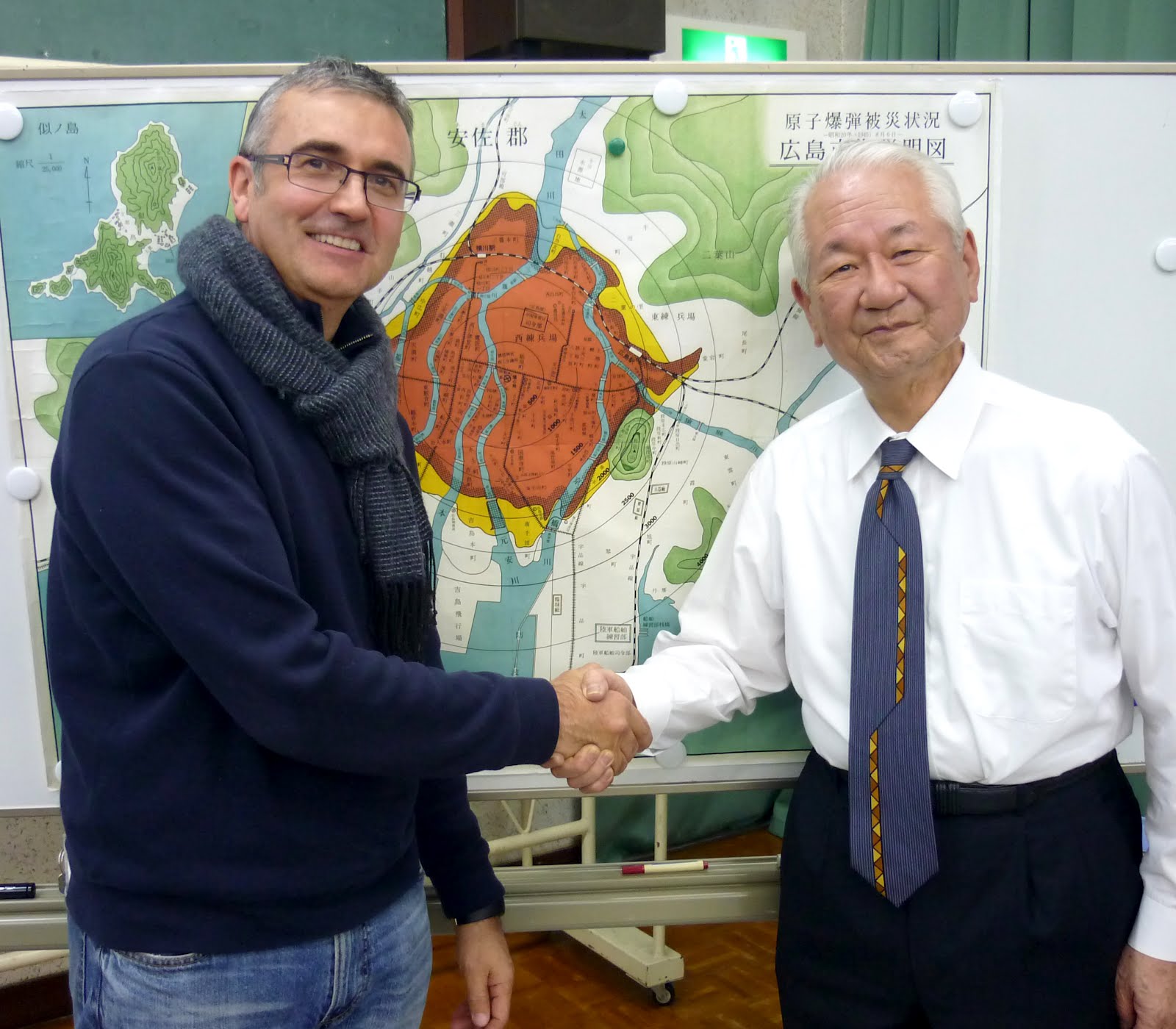
In these days of Middle Eastern uncertainty, as countries once again seriously contemplate the notion of nuclear warfare, it would be well worth leaders going to Hiroshima to remind themselves of the disastrous effects of the A-bomb. This week was my third visit to this historical Japanese city that became known world wide as a result of the events of August 6, 1945. The trip was once again a humbling experience that was no less poignant; as we respectfully viewed the various monuments and museum exhibits that document the circumstances and aftermath of the detonation. However, nothing brings you closer to the experience than hearing the words of those who directly experienced it and we were fortunate to meet with one of the dwindling number of survivors who are able to share their memories of this fateful day.

Mr. Katsuto Osumi is a stately gentleman whose dignified appearance and positive outlook belied the horrific experiences of his youth. He was seven years old when he witnessed first hand the blinding flash of white light from the A-bomb as he stood only two kilometers from its epicenter. Amazingly he suffered relatively few outward injuries, but years later his intense exposure to radiation would take its toll, as he would eventually contract three different forms of cancer over the ensuing years. He spoke vividly about of the unbelievable days immediately following the bombing as his family survived on grass and frogs in the nearby mountains, in constant fear of yet another attack. He remembered, as if it were yesterday, the steady flow of corpses drifting down the river, which were dragged onto the bank only to lay decaying until eventually being burnt on makeshift funeral fires that in turn created an all pervading stench that lasted for weeks. Eventually he would return to the city, only to witness the slow ongoing deaths of family and friends over the months and years ahead. In later years, as his own health issues emerged, he thought how strange it was that he would be treated using radiation, as this is what he had been told had actually caused his problems. He spoke of the discrimination that would emerge toward A-bomb victims and the embarrassment of revealing to potential marital partners that you had suffered radiation exposure, as sterility or the possibility of deformed births remained an ongoing social fear. Despite all this, Mr. Osumi continued to demonstrate throughout his life the resilience of the human spirit and his own ability to think positively through adversity. He worked for many years in a large Japanese corporation, becoming the oldest player in the company’s baseball team, before eventually leaving, whilst in his 50’s, to establish his own successful sales company. He holds no animosity about what happened to him and despite his ongoing health issues and treatment, genuinely expects to live well beyond 100 years. Yet, no matter how many years lay ahead, he remains firmly committed to relaying to others his own very personal experiences and to reminding us all about the horrors of nuclear warfare. His softly spoke words were testament to the destructive toll of such weapons and the long-term physical and psychological effects they can have upon individuals and a society as a whole.

While the city of Hiroshima has certainly emerged from the ashes, the sorrow it carries lies just below the surface, providing a sobering lesson for the current nuclear-armed countries to reflect upon.

Saturday, 4 February 2012

Osaka on Two Wheels

While Japan is known throughout the world for its automotive dominance, the number of cars on their roads would simply pale into significance to the amount of bikes. As we have found out, bicycles are widely used throughout the city and country by people of all ages and social standing. I recently read that around 60% of the population actually own their own bike, so that’s around about 73,000,000 throughout Japan! They come in a variety of forms, but unlike the highly stylised locally produced cars, the bikes here generally appear quite old fashioned. They are built for function rather than looks, most are single geared and come with a basket and carry rack. With bike theft being the number one crime in Japan, each bike has its own key lock and for added security, is registered with the local police. Each day a myriad of cyclists can be seen commuting to work, school or to the local train station. Indeed, around most stations there are multi-storey parking stations dedicated for bikes, while just about every vacant space around town has been adapted into bike parking area.

Their presence certainly cannot be ignored as we walk around our local streets, with Jules and I both having a few close shaves from cyclists who have suddenly whizzed past at high speed. Technically they are supposed to use the road, unless otherwise indicated by a signpost, but this rule seems to be largely ignored, so there always remains a certain element of risk in just taking a stroll. It’s not that we don’t like bikes, but it can be a very dodgy experience when you combine their high speed, the narrow pathways and a distinct lack of warning as they approach from behind. Here they have a habit of suddenly creeping up on you, only to scare the living daylights out of you when they suddenly pass just inches away. We often wonder whether they feel that they are being somehow impolite by ringing the bell, or maybe it’s just the sheer bravado of many riders in thinking that they can successfully dodge around the unsuspecting pedestrians without them even knowing…who knows! In any case, we remain constantly on the alert, with one eye looking over our shoulders. We have even been quite wary about walking side by side in case we further narrow the gap that a rider can squeeze through and inadvertently increase the chance of an accident.

We’ve been told that bike related accidents are notoriously high, as clearly the bicycle rules here are particularly sketchy, with only one major rule that seems to exist … ‘Don’t have an accident’! If any laws do exist they won’t actually be enforced unless you have one. This includes what you might get up to while riding your bike. It is not uncommon to see someone riding the streets while carrying an open umbrella, listening to their iPod or talking on their mobile phone; possibly all at once! Likewise, there doesn’t seem to be any restrictions on carrying passengers, with toddlers often placed in the front basket or friends hanging on precariously while sitting on the back carry rack. Amazingly enough, we have also yet to see anyone wearing a helmet, even though apparently 40% of road fatalities are cyclists! This is not totally surprising, as there certainly seems to be a nonchalant attitude toward bike riding and the general rules of the road.

Friends often ask me if I’m ever going to get a bike and then look quizzically when I state that I am happy just to walk. Sure, you might get there quicker, but for the time being I’ll keep my feet on the ground and take my chances treading the footpaths of Osaka.

Saturday, 14 January 2012

A Night at the Races

It has been many years since Jules and I have been to the horse races, but the opportunity to visit Hong Kong’s Happy Valley Races was simply to good to resist. It remains one of the cities major attractions and is always listed as a ‘must see’ while in town. However, there are a few things that make this particular race meeting different from many others in the world. The location of the track is right in the heart of Hong Kong, which makes it particularly accessible, while the towering buildings that surround ‘The Valley’ adds to it’s unique atmosphere. Looped by the cities famous double decker trams, this weekly event attracts thousands of race goers every Wednesday night. Indeed, the fact that it’s a night time race meeting has probably been the biggest reason for its success over the years, with punters regularly streaming in after work to enjoy the colourful and exciting spectacle.

So for the first race meeting of 2012, Jules and I decided to join the crowd. We had found out about a special tourists ticket that enabled us to gain access to most areas of the course, so we walked casually through the members entrance as if we knew all about the racing world, which we certainly don’t. The first thing that struck us was the sheer size of the track and grand stand area. This was clearly an event that took pride in its status as a longstanding Hong Kong tradition and has continued to reflect its success through ongoing upgrades of its facilities. The sense of wealth was obvious and over the years it has clearly attracted some of the major owners, trainers and jockeys from around the world. On the night we were there, top Australian jockey Darren Beadman was on board several horses. In fact, he rode one of our first winners, although I must admit these were actually ‘hypothetical bets’ that we were having when we first arrived. It was unfortunately a very different story when we began to place ‘real’ money on our tips. Like so many other punters before us, our foolproof system of choosing horses based upon their names eventually let us down. However, our meager losses didn’t detract from the fun of the evening. We simply enjoyed sitting high in the members stand eating our Chinese dinner (a little different than the regular Aussie pie and chips) and watching the activities below. Whether it was the sizable brigade of ‘divot fillers’ who systematically ventured onto the track between races, the horses parading before their big race or the roar of the excited crowd at finish line, it was all part of a big night at the Hong Kong races.

Sunday, 8 January 2012

Our Hong Kong Stopover

After a great Christmas of catching up with family and friends, we headed back to Japan, but this time it was suggested that we might like to break up our journey with a quick stop over in Hong Kong. As we had never been there before we thought that would be a terrific idea, so we allowed a little time and just a bit of space in our suitcases for some last minute shopping. After all, ‘spending’ is what this city was built upon and it continues to live up to its reputation as one of the great ‘retail’ capitals of the world. Jules was certainly in her element, although we were both amazed by the sheer number of ‘high end’ shops, many of which were simply out of our league. Nonetheless it is fair to say we did make a small contribution to the local economy as we continued to explore this bustling city over the next three days.

Being winter we tended to limit our sightseeing, but of course a trip to Hong Kong is not quite complete without a visit to Victoria Peak. So we jumped on board the funicular railway and made our way up the steep slope. As we headed upward, we were literally pushed back into our seats by the sheer angle of the incline and with the increasing chill factor, it gave us some idea of our viewing altitude. Yet, despite the cloudy haze, there was no denying the quality of the ultimate view. It certainly provided us with an amazing insight into the scale, architectural achievements and population density of this great city.

By sunset we were back down at sea level and enjoying a nice cocktail at the ‘Felix’ bar (designed by Philippe Stark) at the iconic Peninsular Hotel. This landmark of Hong Kong was originally built in 1928 and remains a lasting reminder of the British colonial days when the hotel entertained rich and famous visitors who had traveled from Europe on the Trans-Siberian rail link. More recently the grand hotel was a pit stop for Michael Palin as he traveled ‘Around the World in 80 days’. From here we headed down to the foreshore to watch the nightly light show from the Kowloon side of the harbour. Lasers scanned the sky and coloured lights danced across various high-rise buildings, adding to the excitement of Hong Kong by night. However I must say, the colourful skyline was just as impressive from the vantage point of the water ferry that regularly moves back and forth from Hong Kong Island and the mainland.

The next night we had the opportunity to explore the nightlife a little further when we caught up with our friends from Japan who had originally suggested our stop over. As regular visitors, they certainly knew all the best spots and had no hesitation in recommending that we head to the Soho entertainment district. This was not far from our hotel and was easily accessed by the extensive overhead walkway, which has what is recognised as the worlds longest escalator system. This was quite an amazing part of the old town; filled with restaurants, bars and nightclubs and on a Friday night it was really jumping, with happy crowds spilling into the streets. Clearly the expat community had discovered this neighborhood many years ago and had cultivated it into a very popular nightspot. We had previously explored the somewhat quieter side of this area during the day, as it is renowned for its many small galleries and antique shops, as well as the nearby Graham Street Market, which is the oldest continually running street market in Hong Kong (160 years). As an expert on the worlds great food markets and as a true connoisseur of fresh produce, Jules was in awe of what this place had to offer and of its ridiculously cheap prices. It seemed that whether it was the humble street market or the exclusive luxury brand arcades, Hong Kong had something for everyone and we had only just begun to scratch the surface! I suspect that this won’t be our last Hong Kong stopover, but I think there may be the need for a little more suitcase room next time.

Sunday, 1 January 2012

Trekking the Mount Lofty Pass

It is over ten years ago since my good friend Daryl suggested that we should both tackle a walk to the top of Mount Lofty, the tallest and only significant mountain close to Adelaide. I guess at that stage in our lives we had the ominous feeling that middle age spread was beginning to set in, so we were both looking for interesting options to improve our fitness. A trek up a misty mountain in the early hours of the morning had a certain challenging appeal! We knew that the Waterfall Gully to Mt. Lofty walking track had been there since the pioneer days of South Australia, rambling upward to the summit, providing a 7.8km round trip walk. At that time the trail had remained relatively unchanged, despite the fact that many an intrepid hiker had tackled the steep slopes over the years. As we found out for ourselves, the narrow path weaved through gum trees, over rocks and across mountain streams, occasionally providing tantalizing glimpses of the flat pains below. At the summit we were rewarded for our efforts with a spectacular 180-degree panoramic of the city and surrounding area, as well as coastal views across Gulf St.Vincent through to Yorke Peninsula on a clear day.

Over the years Daryl and I had always enjoyed this leisurely walk and in between huffing and puffing, it allowed us time to talk and reflect upon the events of the day. We solved many of the world’s problems on that trail, while also seeking each other’s opinion on life’s big issues. Whether it was in the scorching heat of summer or the drizzly depths of winter, we regularly enjoyed the picturesque walk and it remains a ritual that I have missed since we moved overseas. On this trip home, Daryl and I again tackled the trail, both a little older, but no less enthusiastic. To be honest, the trek is a little different today than my ‘watercolour memories’ of it from all those years ago. It has clearly become much more popular and as a result has subsequently undergone considerable upgrades. The rocky, uneven tracks that I remember, have now been widened and paved in many areas to cope with the increased foot traffic, with seats and resting points along the way. New generations of hikers, fitness fanatics, nature lovers, tourists, families and friends have been introduced to the this unique walking trail and not surprisingly it has now developed into one of Adelaide’s most popular natural attractions. From our traveling experience, its close proximity to the city still remains quite unique on the world stage and with an easy 15 minutes drive from the city, it provides a seamless transition from the suburbs into natural bushlands. However, in order to admire the stunning view you will need to work a little harder than that! Although the trail is not too punishing, it is challenging enough and in the end, if your prepared to give it a go, I can guarantee that you won’t be disappointed with the outlook or the satisfaction you will feel as you head down the somewhat easier down hill run.